Assembly puzzle games are not popular because players love typing obscure instructions. They are popular because they remove almost everything else. With only a few registers, tiny programs and strict timing, you learn what computation feels like before abstractions hide it.
## Constraints are the lesson
In a high-level language, you can usually ask for more: another array, another helper function, another object, another library. Assembly puzzle games refuse that comfort. A TIS-100 node has almost no memory. SIC-1 gives you one instruction. SHENZHEN I/O makes board space and component cost matter. EXAPUNKS asks you to coordinate tiny agents that can copy, move, test and die.
That pressure changes how you think. You stop asking “what would be convenient?” and start asking “what is the smallest state I need?” You learn that data must be somewhere, that loops have cost, that branching creates edge cases, and that an elegant solution is often the one that deletes a clever idea rather than adding another layer.
This is why assembly games are useful even if you never plan to write production assembly. They train precision. Every instruction is visible, every temporary value has to be accounted for, and every shortcut has a measurable consequence.
## The essential assembly puzzle games
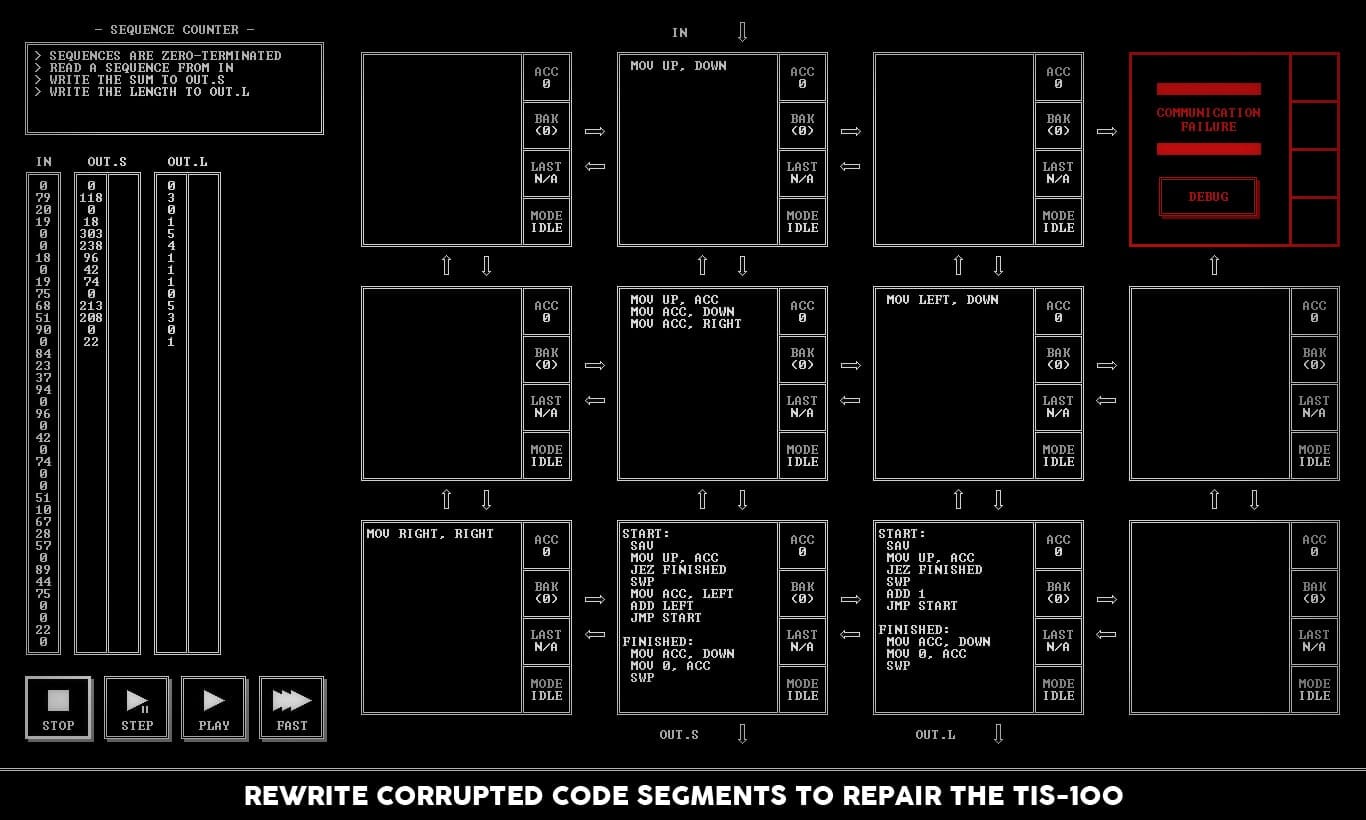
Reverse-engineer a corrupted parallel computer by writing assembly for its tiny nodes. Zachtronics’ cult open-ended assembly puzzler.
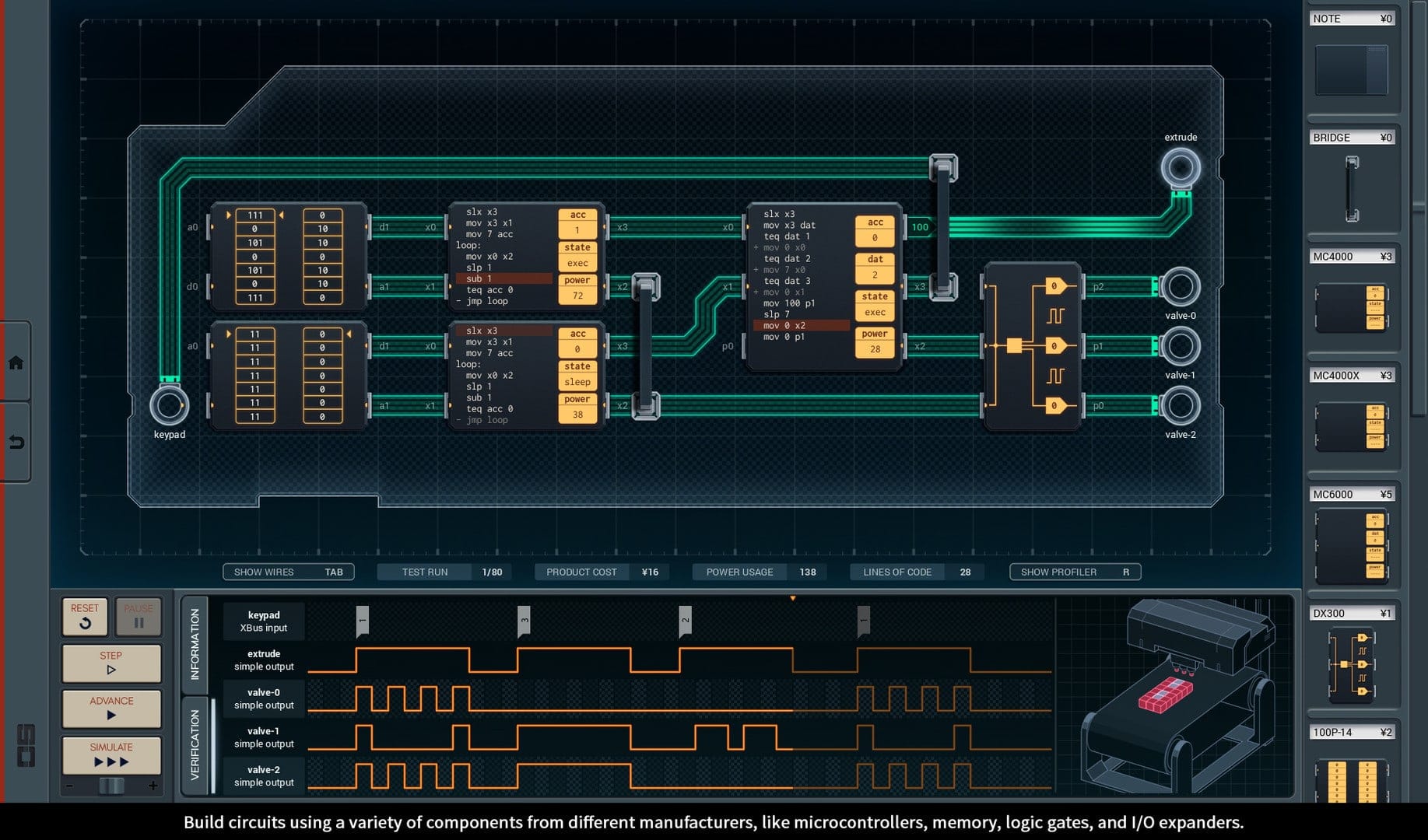
Build circuits and write microcontroller assembly to make gadgets for a shady electronics firm — datasheets, debugging and all.
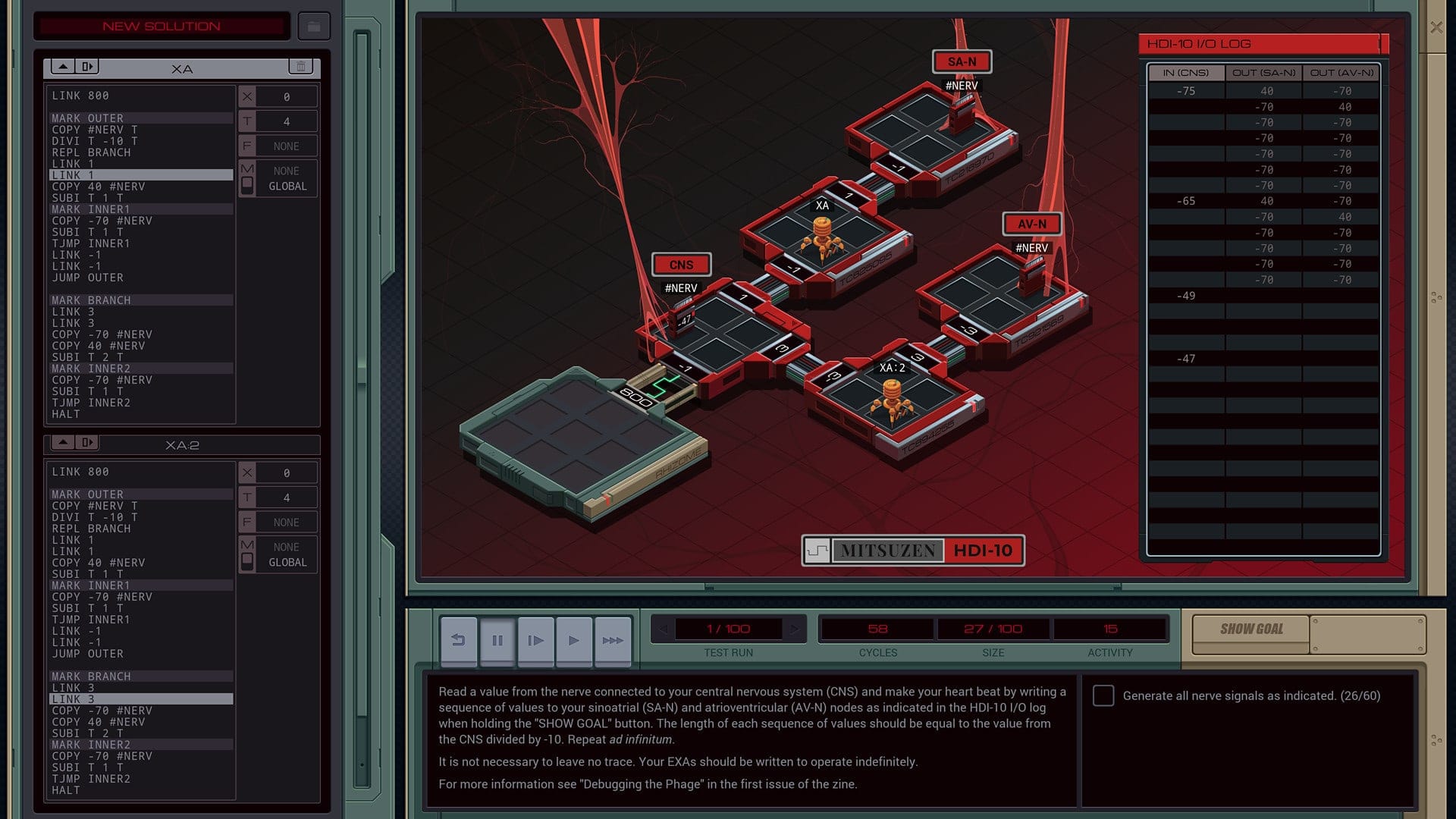
It’s 1997 and you’re a hacker with a disease only an illegal procedure can cure. Write EXA agents to infiltrate machines and steal what you need.
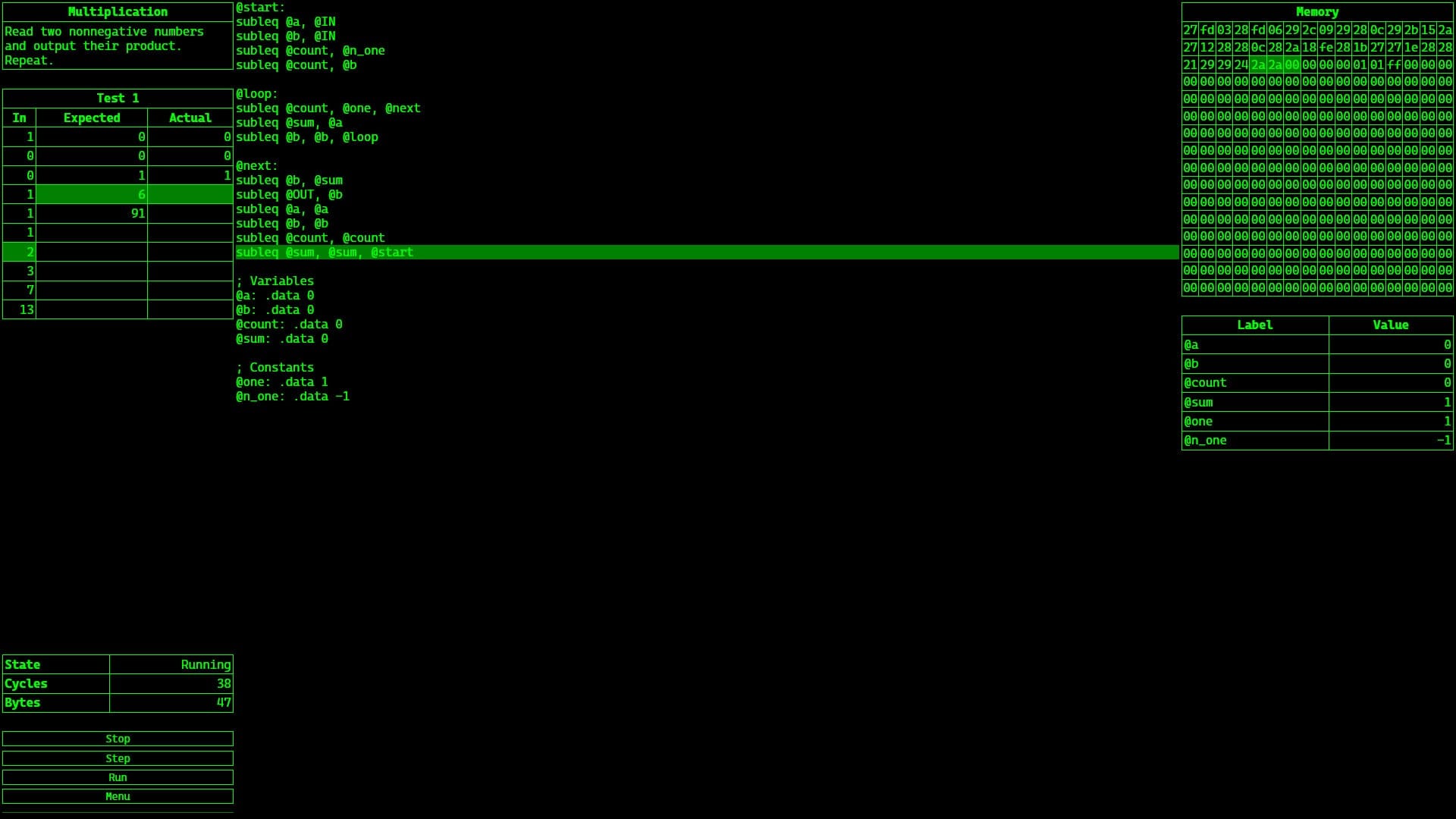
A single-instruction computer where every program is built from nothing but "subtract and branch". Free, brutal, addictive.
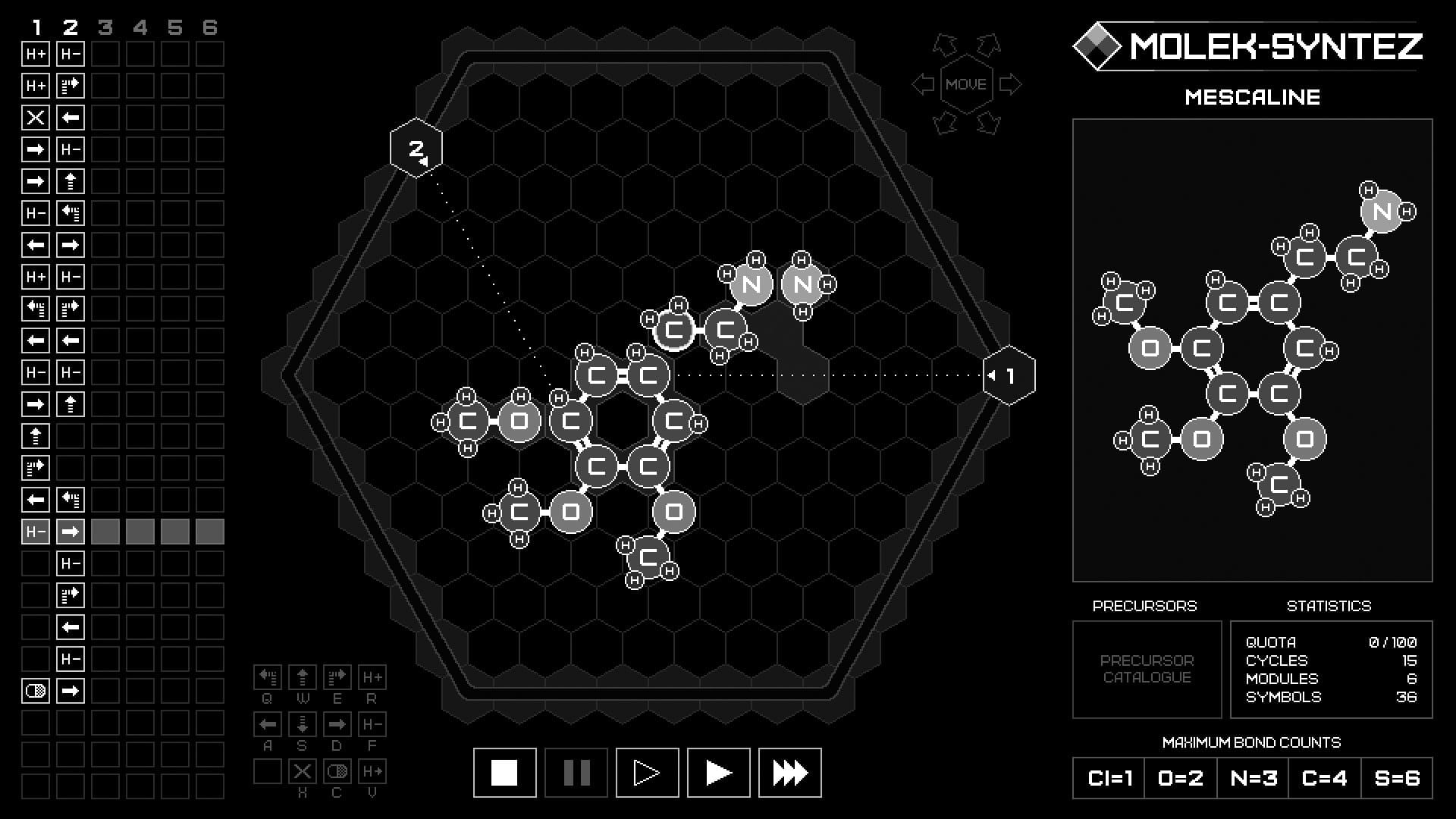
Synthesise molecules on a low-level machine in a bleak Romanian apartment. A lean, cheap successor to SpaceChem.
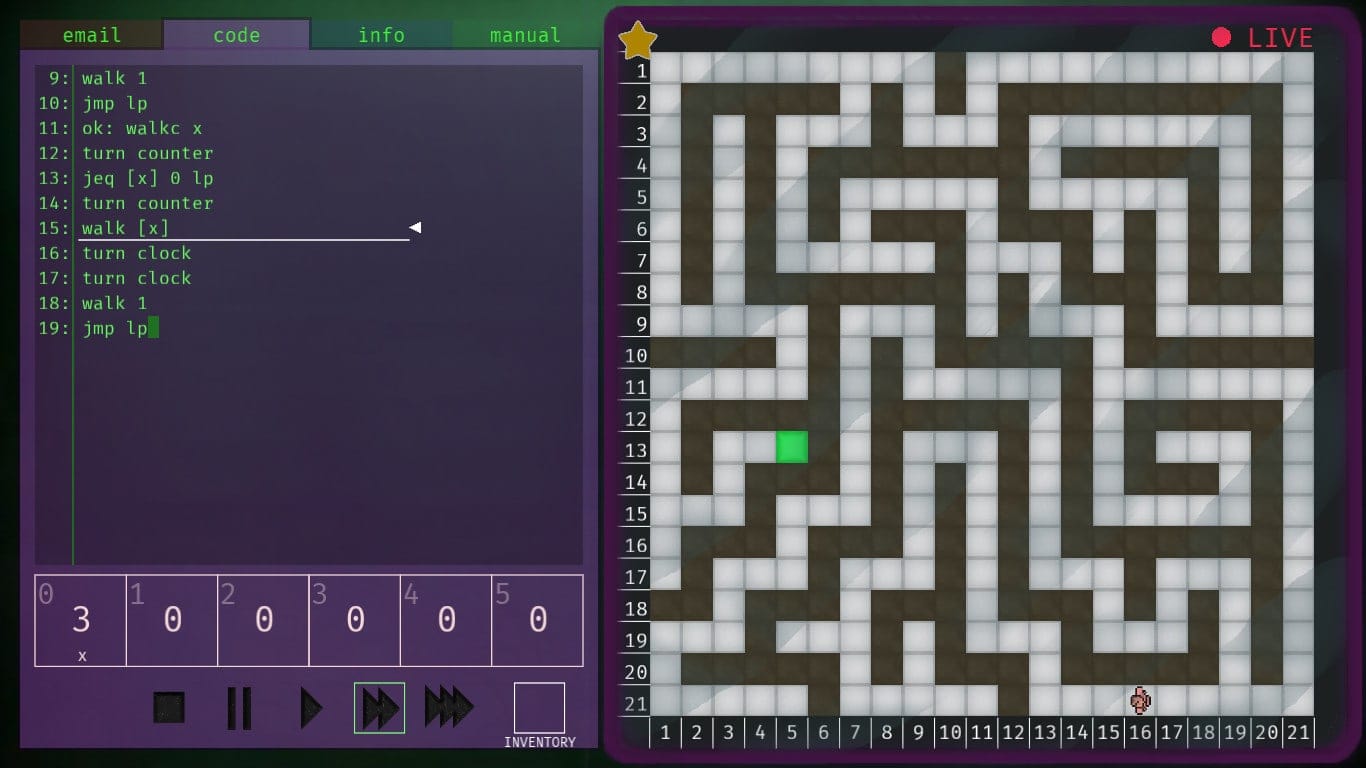
Program corporate robots in a tongue-in-cheek assembly to run a dystopian megacorp’s operations.
TIS-100 is the cleanest starting point for pure instruction-level thinking. SHENZHEN I/O adds hardware context: you are not only writing code, you are choosing parts and wiring signals. EXAPUNKS is more theatrical and kinetic, with little programs moving through networks like agents. SIC-1 is the extreme minimalist option, reducing computation to subtract-and-branch. MOLEK-SYNTEZ and Marvellous Inc. sit nearby, using low-level logic and optimization pressure in slightly different costumes.
## What assembly games teach better than tutorials
First, they teach data movement. Beginners often imagine computation as a cloud of ideas. Assembly games make it physical: a value comes from a port, goes into a register, gets modified, waits, then moves somewhere else. If the value is in the wrong place at the wrong time, the program fails.
Second, they teach control flow. A loop is no longer a comfortable keyword. It is a jump, a condition and a decision about where the next instruction pointer should go. That makes off-by-one errors and missing exit conditions easier to understand because you can see the machine repeating your mistake.
Third, they teach optimization without hand-waving. Many games show histograms for cycles, size or cost. That turns improvement into a concrete question: can you use fewer instructions, fewer nodes, less area or less time? The score is not abstract. It is a mirror for the structure of your solution.
## A taste of the syntax
A tiny TIS-100-style node can be explained in seconds: read a value, double it, send it onward. The hard part is not the syntax below; the hard part is making several tiny nodes cooperate when inputs arrive at different times.
# read from the top port, double it, send it down
MOV  UP, ACC
ADD  ACC
MOV  ACC, DOWN
The example is deliberately small. Assembly puzzle games become interesting when that tiny pattern is embedded in a larger network: one node filters, another counts, another stores, another routes, and the whole solution depends on timing.
## Why experienced programmers benefit
If you already write software, assembly games are a useful antidote to abstraction drift. They remind you that memory, timing and state are real. A slow query, a race condition, an inefficient loop or a bloated data structure may look different in production code, but the underlying discipline is the same: know what changes, know when it changes and know why the next step is valid.
They also make debugging less emotional. When a four-instruction program fails, there is nowhere to hide. You learn to trace, not hope. That habit transfers directly to larger systems.
## Where to start
Start with TIS-100 if you want the iconic version of the genre. Choose SHENZHEN I/O if hardware and datasheets sound appealing. Choose EXAPUNKS if you want story and movement around the low-level logic. Choose SIC-1 if you already like constraints and want the sharpest possible version of the idea.